
I would say, 'Tell me about what happens at the end of the world,' and she would describe her vision of that, which was these crazy things with people's hands falling off and their clothes burning up and the light in the sky turning on and off really fast, like all these visions that she has. And I remember — this is just one example — but I remember asking her, 'If all these things were your fault, what would you do?' And she said, 'I would just try to fix it. I would do whatever I can to fix what I broke.' And then I said, 'What would you do to fix it?' And she said, 'Well, I would always brush my teeth. I would listen to my parents.' Read NPR's interview with Benh here.
Meet Hushpuppy
"The look in her eyes and the intensity, and the amount of feeling that you could see was going through her head, behind her eyes, was so powerful."
Meet the one and only Hushpuppy, Quvenzhané Wallis.
Benh Zeitlin's Bathtub
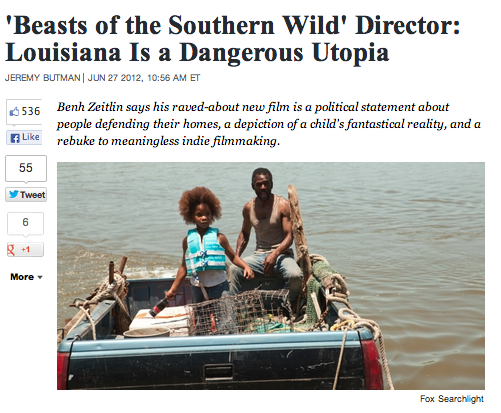
Back in June 2012, just before the theatrical release of Beasts of the Southern Wild, journalist Jeremy Butman sat down with Benh Zeitlin to discuss the filmmaker's take on The Bathtub and the ideas and themes the film represents.
And of course the storm is going to recall Katrina. So it seems as though it has an absolute analogue in the real world. How is the audience supposed to understand the connection between the mythological setting of Beasts and the real southern Louisiana?
I think it's very different inside and outside of Louisiana. In Louisiana, especially when you get outside New Orleans, the storm in the film and the issues with the storm are much more inspired by [Hurricane] Gustov and current land-loss in south Louisiana and the levee issues around the Mississippi and salt water intrusion and the oil spill and all this other stuff that for me was actually more the reference point. I feel like that's what it will be for people there, too. It's been interesting as I show it outside there that it's going to go to Katrina, because that's what people think of when they think of storms in Louisiana.
The reason I wanted to do this story was that I'm interested in the current moment of living in south Louisiana, where there's a group of people, and a world, that knows they're under threat constantly, but they're totally entrenched in living there, and they're not going to leave. I wanted to try to understand that impulse, that impulse as an observer and then also my personal impulse to move there and live there the rest of my life—why do you do that?
Read the full, in depth interview here.